Choosing the right Air Conditioner Filters is not a minor maintenance decision. It affects airflow, indoor comfort, equipment performance, and the particles circulating through a room. A dusty bedroom, a shedding pet, or nearby construction can change what your system needs. The best filter depends on your household, HVAC design, and replacement habits.
Dr. William P. Bahnfleth, an indoor-air-quality researcher and ASHRAE expert, has said, “There is no magic bullet for indoor air quality.” That warning matters here. A filter with a higher MERV rating can capture smaller particles, but it may also restrict airflow in systems that were not designed for it. Efficiency is only useful when the equipment can handle it safely. Check the manufacturer’s specifications before upgrading.
Small details matter. Measure the filter, rather than trusting its printed size. A loose frame can allow unfiltered air to slip around the edges. Watch for gray pleats, rising energy bills, or weaker airflow. These signs can reveal a neglected filter.
The perfect filter does not exist.
This guide compares MERV ratings, fiberglass, pleated, electrostatic, and HEPA options. It also considers allergies, pets, smoke, maintenance costs, and system compatibility. Some recommendations may feel obvious, yet real homes are rarely simple. A filter that works well in a clean office may clog quickly in a busy family room. The right choice is practical, measurable, and reviewed over time.
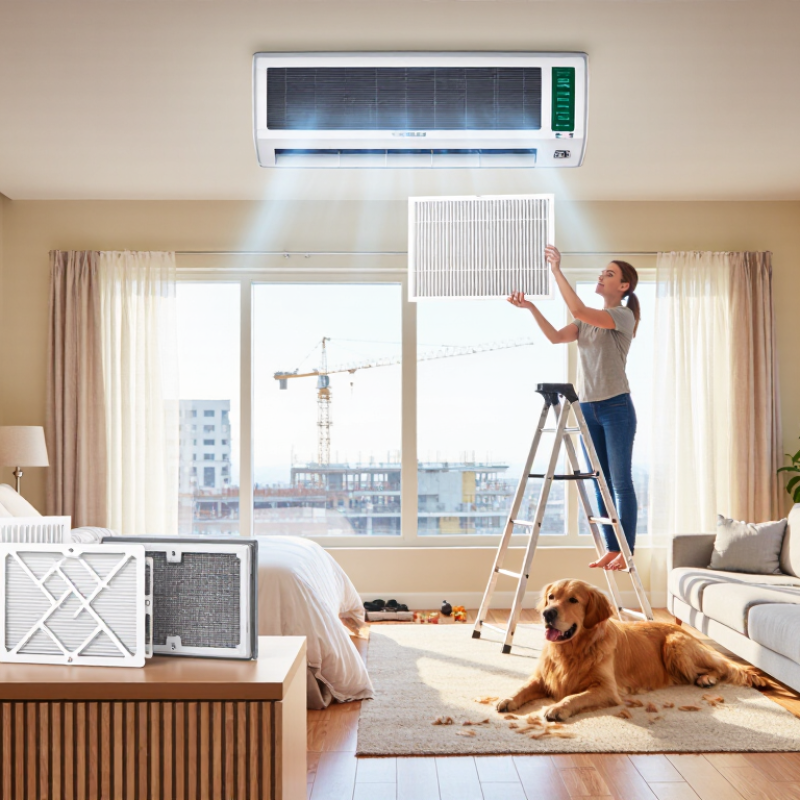
Understanding How Air Conditioner Filters Work
How to Choose the Best Air Conditioner Filters?
Understanding How Air Conditioner Filters Work
An air conditioner filter is more than a dust screen. Return air passes through tightly arranged fibers before reaching the indoor coil. Larger particles strike the fibers directly. Smaller particles follow air currents, touch the fibers, and remain attached. Very tiny particles may move randomly and collide with the material. This process is called diffusion.
Airflow matters. A filter with a higher MERV rating can capture more particles, but it may also create greater resistance. ASHRAE Standard 52.2 measures filter performance under controlled laboratory conditions. It does not guarantee the same results in every home. The U.S. Environmental Protection Agency recommends MERV 13, or the highest rating a system can safely handle. That qualification matters.
Not just dust.
The EPA reports that indoor pollutant concentrations can be two to five times higher than outdoor levels. A properly fitted filter helps reduce airborne particles, including some pollen and fine dust. It cannot remove every pollutant. Gaps around the frame can let dirty air bypass the filter completely. In practice, that small gap can defeat an expensive upgrade.
Check the filter monthly during heavy cooling periods. Replace it when visibly loaded, or sooner if airflow weakens. I have seen homeowners choose the highest rating without checking system pressure. That decision sounds sensible, yet it can reduce comfort and increase strain. Filter choice should balance particle capture, airflow, equipment guidance, and local conditions.
Identifying the Right Filter Type for Your System
How to Choose the Best Air Conditioner Filters?
Identifying the Right Filter Type for Your System
The right air conditioner filter starts with your system, not the highest efficiency rating. Check the existing filter’s dimensions, airflow arrow, and recommended rating. A filter that fits loosely can let dust bypass the media. That defeats its purpose.
Flat fiberglass filters usually offer basic particle protection and low airflow resistance. Pleated filters capture smaller particles and often suit standard residential systems. However, denser media may restrict airflow in older equipment. Your system manual should confirm the acceptable rating, such as a suitable MERV range. If the manual is missing, ask a qualified technician to measure airflow and inspect the filter slot.
Households with pets, allergies, or renovation dust may need finer filtration. HEPA-grade filters can be effective, but many regular air conditioners cannot handle them without modification. Listen for whistling, weak airflow, or longer cooling cycles. These signs deserve attention.
Do not ignore the frame.
A practical check is simple: remove the filter and look for heavy dust, bent edges, or moisture stains. Replace it when loaded, not only when the calendar says so. Monthly checks work well during heavy-use seasons, though real replacement intervals vary. I have found that choosing a highly rated filter too quickly can create more problems than it solves. The better decision balances particle capture, system capacity, indoor conditions, and verified fit.
Comparing Filter Ratings, Materials, and Airflow
Choosing the Best Air Conditioner Filters: Ratings, Materials, and Airflow
Choosing an air-conditioner filter requires balancing particle capture with airflow. MERV ratings, tested under ASHRAE Standard 52.2, measure filtration performance, not overall system quality. The U.S. Environmental Protection Agency reports that indoor pollutant levels can be two to five times higher than outdoors. That makes filtration important, but higher is not automatically better. An overly restrictive filter can reduce air volume, create noisy vents, and strain a small blower. Check the equipment manual before selecting a high rating.
Fiberglass filters usually offer low resistance and basic dust control. Pleated synthetic filters capture finer particles, while deeper media provides more surface area. Yet material labels can mislead. Look for a verified pressure-drop value, measured in inches of water column, at your system’s airflow. The U.S. Department of Energy’s Energy Saver guidance recommends inspecting filters monthly and replacing them when loaded. Homes with pets, smoke, or renovation dust may need closer attention.
Tips: Hold the filter toward a bright window. If light barely passes, airflow may be restricted. Record the installation date. Ask a qualified technician to measure pressure drop when comfort changes, coils frost, or rooms feel weakly supplied. EPA’s Guide to Air Cleaners in the Home also stresses source control and ventilation, because filters cannot remove every indoor pollutant. That limitation deserves honesty.
How to Choose the Best Air Conditioner Filters?
Comparing MERV ratings, particle capture, and airflow resistance
Higher MERV ratings generally capture more particles in the 0.3–1 micrometer range, but they can also create greater airflow resistance. The efficiency values shown are the minimum E3 thresholds used in the ASHRAE 52.2 MERV classification. Pressure-drop values are representative clean-filter readings at approximately 500 feet per minute and vary by filter thickness, media material, and construction. Fiberglass filters usually have lower resistance, while pleated synthetic or electret media can provide higher filtration with a larger pressure drop.
Choosing the Correct Filter Size and Fit
Choosing the Correct Filter Size and Fit
Choosing the correct air conditioner filter starts with accurate measurements. A filter can look right while leaving gaps around its frame. Dust may then bypass the filter and collect on the coil.
Check the existing filter’s length, width, and thickness. Measure twice. Fit matters. Do not rely only on printed dimensions, because actual sizes may differ slightly. Also inspect the filter slot, not just the old filter. A damaged frame or bent track can create an unnecessary gap. In routine HVAC maintenance, this small detail is often overlooked.
The replacement filter should slide in smoothly but remain secure. Too much force may bend the frame or restrict airflow. Too much space allows unfiltered air through. Follow the airflow arrow printed on the filter. It should point toward the indoor unit or blower. If the slot has no clear direction, check the equipment manual or ask a qualified technician.
A common mistake is choosing a thicker filter because it seems more protective. However, thickness can affect airflow if the system was not designed for it. Check the recommended size and filter rating before buying. I would recheck the fit after installation, especially if the filter rattles when the system runs. Seasonal humidity, dust, and repeated removal can also change how firmly the filter sits.
Planning Filter Replacement and Maintenance Cycles
How to Choose the Best Air Conditioner Filters?
Planning Filter Replacement and Maintenance Cycles
Filter replacement should follow real operating conditions, not only a calendar reminder. The U.S. Department of Energy reports that replacing a dirty, clogged filter can reduce air-conditioning energy use by 5% to 15%. A basic home may need replacement every one to three months. However, homes with pets, renovation dust, smokers, or frequent cooling may need shorter cycles. Check the filter monthly. It takes minutes.
Choose a filter with a suitable MERV rating, but higher is not always better. The U.S. Environmental Protection Agency recommends MERV 13, or the highest level the system can handle safely. A filter that restricts airflow can increase pressure, noise, and equipment stress. Read the equipment manual. Measure the actual filter slot. A printed size may differ slightly from the real dimensions. That small mistake matters.
Tips: Mark the installation date. Inspect the filter under bright light. If the surface looks gray or airflow feels weak, replace it early. Keep one spare filter nearby. Use a simple log for dates, dust levels, and cooling hours. The three-month rule is convenient, but imperfect. I would adjust it after observing one full cooling season. A clean filter supports comfort, but maintenance also includes coils, drains, and airflow checks by a qualified technician.
How to Choose the Best Air Conditioner Filters? - Planning Filter Replacement and Maintenance Cycles
| Filter Category |
Typical Efficiency |
Typical Clean-Filter Pressure Drop* |
Recommended Replacement or Cleaning Cycle |
Best Application |
Important Maintenance Notes |
| Disposable Fiberglass |
MERV 2–4 |
Approximately 0.05–0.15 in. w.g. |
Replace every 30 days; inspect every 2–4 weeks |
Basic dust protection and systems with low filtration requirements |
Low resistance, but limited capture of fine particles. Replace sooner in dusty conditions. |
| Pleated Synthetic or Cotton |
MERV 5–8 |
Approximately 0.10–0.25 in. w.g. |
Replace every 60–90 days; inspect monthly |
Most residential air-conditioning and forced-air systems |
A practical balance between particle capture and airflow. Confirm that the equipment supports the selected rating. |
| High-Efficiency Pleated |
MERV 9–12 |
Approximately 0.15–0.35 in. w.g. |
Replace every 60–90 days; inspect every 30 days |
Homes needing improved control of fine dust, pollen, and some airborne particles |
Higher efficiency can increase airflow resistance. Monitor cooling performance and use the equipment manufacturer’s airflow limits. |
| Very High-Efficiency HVAC Filter |
MERV 13 |
Approximately 0.20–0.45 in. w.g. |
Inspect monthly; replace about every 60–90 days or when loaded |
Systems designed to provide stronger filtration of fine particles |
Use only when the air handler, fan, and duct system can maintain the required airflow at the added resistance. |
| Washable or Reusable Filter |
Often MERV 1–4; verify the tested rating |
Varies widely by design and condition |
Vacuum or wash every 30–90 days; replace when damaged or permanently loaded |
Applications where routine cleaning is convenient and basic filtration is sufficient |
Allow the filter to dry completely before reinstalling. Do not use a reusable filter if its frame or media is damaged. |
| HEPA or HEPA-Grade Module |
Typically equivalent to MERV 17–20 when properly tested |
Often higher than standard residential filters |
Inspect every 1–3 months; replacement commonly ranges from 6–12 months, depending on loading |
Specialized systems designed for very high particle filtration |
Not suitable for every central air-conditioning system. Installation should be based on verified airflow and pressure-drop requirements. |
*Pressure-drop note: Values are typical planning ranges for clean filters and vary with filter size, airflow rate, pleat depth, media design, and loading. Always check the filter’s test data and the air-conditioning equipment manufacturer’s requirements before selecting a higher-efficiency filter.
Light-Use Schedule
Inspect every 60 days and replace disposable filters approximately every 90 days.
Normal-Use Schedule
Inspect monthly and replace disposable filters every 60–90 days.
Heavy-Use Schedule
Inspect every 2–4 weeks and replace sooner when visibly loaded, damp, damaged, or airflow is reduced.
FAQS
Start with your system, not the highest rating. Check the filter size, airflow arrow, and equipment manual.
A loose filter allows dust to bypass the filter material. Measure the slot carefully, because printed sizes may differ.
No. Dense filters can reduce airflow, increase noise, and strain smaller blowers. Choose the highest level your system safely supports.
Fiberglass filters provide basic dust protection. Pleated synthetic filters capture smaller particles but may create greater airflow resistance.
Check it monthly. Many homes need replacement every one to three months, but dusty conditions require earlier action.
Pets, smoke, renovation dust, and frequent cooling can load a filter quickly. Keep one spare filter nearby.
Watch for whistling, weak airflow, longer cooling cycles, or rooms feeling poorly supplied. A frosted coil also deserves attention.
Bright-window checks offer a rough clue. If little light passes, restriction may be developing, but this test is imperfect.
Recheck the airflow arrow, frame edges, and actual dimensions. Ask a qualified technician to measure airflow or pressure drop.
No. Filters cannot solve every air-quality problem. Ventilation, source control, and regular equipment maintenance still matter.
Conclusion
Choosing the best Air Conditioner Filters begins with understanding how they protect your indoor air and support your cooling system. Filters capture dust, hair, pollen, and other particles as air moves through the unit, but a filter that is too restrictive may reduce airflow and increase energy use. Start by identifying the filter type recommended for your system, then compare ratings and materials according to your household needs, indoor air concerns, and equipment capacity. Higher filtration is not always better if the system cannot handle it efficiently.
Accurate sizing is equally important. Check the existing filter, the system label, or the owner’s instructions for the correct length, width, and thickness, and ensure the filter fits securely without gaps. Finally, create a replacement and maintenance schedule based on filter condition, usage, pets, dust levels, and household occupancy. Regular inspection and timely replacement can help maintain airflow, support system performance, and promote cleaner indoor air.

 Snow Peak