China’s Aircare Replacement Parts market deserves careful evaluation, not a rushed top-ten list. Replacement filters, humidifier wicks, fan motors, sensors, seals, and control boards directly affect indoor air performance. A low-cost part can look identical, yet fail through poor filtration media, unstable plastics, or inaccurate sensors.
The World Health Organization’s Household Air Pollution and Health update reports approximately 3.2 million premature deaths annually from household air pollution. The U.S. Environmental Protection Agency also notes that indoor pollutant concentrations can be two to five times higher than outdoor levels. These findings make dependable replacement components more than a purchasing detail. They influence maintenance, energy use, noise, and user safety. Dr. Joseph Allen, director of Harvard’s Healthy Buildings program, has described buildings as “a public health intervention.” That perspective applies to every small component inside an air-cleaning device.
This guide examines ten Chinese suppliers through practical criteria, including manufacturing experience, material consistency, testing capability, documentation, customization, and export reliability. Relevant benchmarks include ISO 9001 systems, particulate-removal testing, electrical safety controls, and compatibility records. Supplier claims still need independent checking. That is the uncomfortable part. Factory photos cannot prove batch consistency, and a certificate may not cover the exact replacement model. Readers should request samples, inspection reports, dimensional drawings, and recent test results before ordering. The ranking is therefore a research starting point, not a permanent verdict. Prices change. Capacities change. Quality can change, too.
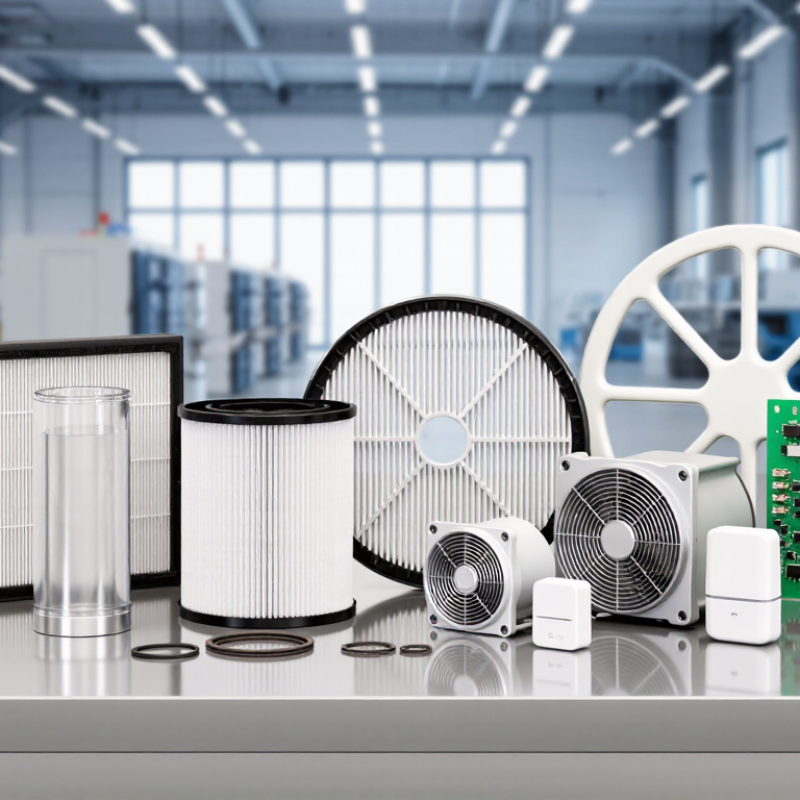
A reliable supplier begins with evidence, not attractive catalog photos. The U.S. EPA reports that indoor pollutant levels can be two to five times higher than outdoor levels. The WHO estimated that 99% of people breathed air exceeding its guideline limits in 2022. Replacement parts therefore need stable filtration, airflow, and electrical performance.
During supplier audits, inspect more than the factory floor. Ask for batch records, material certificates, and test results. A dependable supplier should verify filter dimensions, fan noise, motor temperature, connector fit, and airflow resistance. Small errors matter. A filter frame warped by two millimeters may leak around the seal. That defect can reduce real-world performance, even when laboratory data looks acceptable.
Look for ISO 9001-based quality controls and testing aligned with applicable IEC air-cleaning appliance requirements. Check RoHS and REACH documentation when required by the destination market. Third-party laboratory reports add useful confidence, but they are not enough. Test current samples against production samples. Supply-chain data also deserves attention, including backup material sources and clear lot traceability. A supplier may promise fast delivery, yet weak records reveal future risk. My practical concern is simple: many evaluations focus on unit price first. That is a mistake, sometimes an expensive one. Reliability is proven through repeatable measurements, responsive corrective action, and honest disclosure of limitations.
They were assessed through factory audits, sample testing, quality certificates, export records, and customer feedback. Documented performance mattered most.
Common parts include filters, fan motors, impellers, water tanks, seals, sensors, control boards, and power adapters.
Check dimensions, sealing edges, filter media, filtration grade, and frame fit. A loose frame may let unfiltered air pass.
Buyers should verify voltage, frequency, wattage, connectors, shaft diameter, mounting holes, airflow direction, and temperature limits.
Yes. Motors with similar appearances may produce different noise levels, airflow, or service life. Small differences can matter.
Request drawings, test reports, material certificates, batch records, and corrective-action documents. Independent laboratory evidence is stronger.
Software compatibility may fail. Matching firmware and communication protocols can be necessary, even when dimensions look correct.
They are important. Damaged corners, weak seals, or poor protective materials may appear only after transport.
A trial order compares samples with the original part under real specifications. It reduces installation problems and unnecessary returns.
No. Public information may be incomplete, and some failure rates remain undisclosed. Even strong suppliers can have weaknesses.
China has become an important source of Aircare Replacement Parts, offering a wide range of components for humidifiers, air purifiers, fragrance devices, and related air-treatment equipment. This article explains what makes a supplier reliable, including consistent product quality, accurate specifications, stable production capacity, responsive communication, reasonable lead times, and effective quality-control procedures. It also introduces a practical method for comparing China’s top 10 suppliers through their product range, manufacturing experience, customization options, testing capabilities, export service, and customer support.
The supplier profiles cover major product categories such as filters, water tanks, fans, motors, sensors, control panels, seals, housings, and other consumable or mechanical components. Special attention is given to compatibility standards, dimensions, electrical requirements, materials, and installation details, helping buyers reduce replacement risks. The final section provides guidance on selecting the right partner by evaluating samples, technical documents, production audits, order flexibility, packaging, warranty policies, and long-term cooperation potential. This overview is designed to help importers, distributors, and maintenance providers make informed purchasing decisions in the Chinese replacement-parts market.

 Snow Peak